The underestimated danger: fire statistics in Germany
Fire is one of the deadliest threats in one’s own home – and at the same time the most frequently underestimated. The statistics speak a clear language: in Germany, around 400 people die each year as a result of residential fires. Around 4,000 more suffer serious burn injuries with often lengthy treatment. Material damage from fires in private households and commercial premises amounts to more than 1.2 billion euros per year.
Particularly alarming: around 70 per cent of all fatal fires occur at night while occupants are sleeping. The human sense of smell is largely deactivated during sleep – smoke gases go unnoticed. Just three breaths of toxic fire smoke can lead to unconsciousness. 95 per cent of all fire victims do not die from flames, but from smoke inhalation. That is precisely why smoke detectors are legally required in all German federal states – but as this article shows, a simple smoke detector is by no means sufficient.
Smoke detector obligation – which rules apply in each German federal state
Since 2017, all 16 German federal states have had a statutory smoke detector obligation for residential properties. However, the exact rules differ in detail. In principle, smoke detectors must be installed in all bedrooms, children’s rooms and hallways that serve as escape routes.
Some federal states go beyond this minimum requirement:
- Berlin and Brandenburg: Smoke detectors additionally in all living spaces (living room, study, office)
- Baden-Württemberg: Obligatory in bedrooms, children’s rooms and hallways since 2015, also for existing buildings
- North Rhine-Westphalia: Additional obligation in living spaces that serve as escape routes
- Bavaria: Obligatory in bedrooms, children’s rooms and hallways; the owner is responsible for installation, the tenant for maintenance
- Saxony: Obligatory for new buildings since 2016, for existing buildings with transitional periods
In most federal states, the owner is responsible for installation. Maintenance (annual function check, battery replacement) falls – depending on state building regulations – to the owner or the tenant. Professional remote monitoring via networked smoke detectors considerably simplifies this duty.
The smoke detector obligation is an important first step – but the statutory minimum requirements cover only a fraction of the actual hazards. Standard smoke detectors are pure stand-alone devices: they beep locally, but they do not communicate. Whoever is sleeping in the back room does not hear the detector in the cellar. And no one is automatically alerted when the occupants are not at home.
Why standard smoke detectors are not enough
An inexpensive smoke detector from the DIY store fulfils the legal obligation – but it protects you only to a limited extent. The weaknesses of conventional smoke detectors are numerous and, in practice, potentially fatal:
No networking: Each detector works in isolation. When the smoke detector in the cellar triggers, only the cellar detector beeps – on the second floor you hear nothing. In a burning house, a few minutes can make the difference between life and death.
No notification: Standard smoke detectors have no internet access and no mobile network connection. If you are not at home, you learn of a fire only when it is already too late. A smouldering fire can grow unnoticed for hours and destroy the entire building.
False alarms from cooking vapour: Optical smoke detectors near the kitchen often react to cooking vapour or steam from the bathroom. The consequence: occupants disable the detector, remove the battery or disconnect the sensor. A fatal mistake that is unfortunately widespread in practice.
No differentiation: A simple optical smoke detector cannot distinguish between cigarette smoke, cooking vapour and a real fire. Modern multi-sensor technology solves this problem at its root.
Multi-sensor technology: smoke, heat and CO in one device
Multi-sensor fire detectors represent the current state of the art in residential fire protection. Instead of relying on a single detection mechanism, they combine several types of sensor in one device and intelligently evaluate their signals:
- Optical smoke sensor (photoelectric): Detects visible smoke via light scattering – particularly effective in smouldering fires with strong smoke development
- Thermal sensor (heat detector): Measures the room temperature and detects both rapid temperature increases (differential evaluation) and exceeding fixed thresholds (e.g. 57°C)
- Carbon monoxide sensor (electrochemical): Detects CO concentrations even in low ppm ranges and warns of the invisible danger
The real innovation lies in the algorithm: the integrated microprocessor correlates the signals from all sensors and makes a weighted decision. Cooking vapour, for example, produces optical obscuration but no temperature rise and no CO – the multi-sensor recognises this as harmless and suppresses the false alarm. A real fire, on the other hand, typically produces all three signals: smoke, heat and toxic gases. The combination leads to an immediate alarm with highest priority.
For professional fire protection solutions, at Protexium Security we rely exclusively on multi-sensor technology. Our networked fire detectors communicate via encrypted wireless protocols with the alarm control panel and enable immediate notification of all occupants – regardless of the room in which the fire was detected.
Carbon monoxide – the invisible killer
Carbon monoxide (CO) is a colourless, odourless and tasteless gas that is produced during incomplete combustion. It is insidious because it cannot be perceived by human senses and is life-threatening even at low concentrations. CO binds to red blood cells and displaces oxygen – those affected suffocate without noticing it.
Typical CO sources in residential spaces are:
- Defective or poorly maintained gas boilers and gas heating systems
- Blocked flue gas systems and chimneys
- Wood-burning stoves with insufficient air supply
- Operating charcoal or gas barbecues in enclosed spaces
- Emergency generators near garages
- Car exhaust fumes from attached garages that diffuse into the living area
In Germany, several hundred cases of CO poisoning occur each year, a considerable proportion of which are fatal. Particularly dangerous are so-called “creeping poisonings”: low CO concentrations over a longer period lead to headaches, nausea and dizziness – symptoms that are often mistaken for flu.
“Carbon monoxide is the most common cause of fatal poisonings in Germany. A CO detector can save your life – it belongs in every household with gas appliances, a fireplace or an attached garage.”
A stand-alone CO detector or – even better – a multi-sensor fire detector with an integrated CO sensor warns in good time and gives you the decisive minutes to ventilate the room and identify the source of the danger. In combination with an alarm control panel, the monitoring centre is additionally informed and can immediately alert the fire brigade.
Zone-based fire detection for maximum precision
Professional fire alarm systems work with a zone-based architecture. This means: the building is divided into logical zones (e.g. ground floor, upper floor, cellar, attic), and specific fire detectors are assigned to each area. In the event of an alarm, the system does not merely indicate “fire detected”, but provides the exact zone and the affected detector.
For the fire brigade, this information is invaluable: instead of having to search the entire building, the emergency services can advance immediately to the seat of the fire. In large properties such as building complexes or commercial premises, this can make the difference between a controllable incipient fire and a fully developed fire.
Zoning also enables a differentiated alarm strategy: a detector in the kitchen can be configured with a higher alarm threshold than a detector in the bedroom. Instead of a binary logic (alarm or no alarm), zone-based systems work with staged alarm levels: pre-alarm, main alarm and evacuation alarm – each with different reactions.
Automatic fire brigade notification via the monitoring centre
The automatic forwarding of a fire alarm to a professional monitoring centre is the decisive difference between a simple smoke detector and a life-saving fire protection system. Whereas a stand-alone smoke detector only beeps locally, a monitoring-centre-connected system sends the alarm in real time to a 24/7 staffed monitoring centre.
The sequence of events in a fire alarm with monitoring-centre connection:
- Detection: The multi-sensor fire detector detects smoke, heat or CO and reports to the alarm control panel
- Verification: The control panel checks whether several sensors in the same zone have raised an alarm (cross-verification)
- Transmission: The alarm is sent encrypted via internet and GSM to the monitoring centre
- Contact: The monitoring centre attempts to reach the owner by telephone
- Intervention: In case of a confirmed alarm or if the owner cannot be reached, the fire brigade is alerted immediately
- Documentation: All events are logged and available for insurance and authorities
In practice, this process takes less than two minutes – significantly faster than the average time an occupant needs to call 112 themselves, assuming they have noticed the fire at all. Learn more about the certification requirements for monitoring-centre connection on our information page.
EN 54 – the European standard for fire alarm systems
The European standard series EN 54 defines the requirements for fire alarm systems and their components. It is the authoritative standard for professional fire protection in Europe and is divided into numerous sub-standards, each covering specific components:
| Standard | Subject | Relevance |
|---|---|---|
| EN 54-1 | Introduction and basics | General definitions and system architecture |
| EN 54-2 | Fire alarm control panel | Requirements for control, display and logging |
| EN 54-5 | Heat detectors | Test procedures and classification of temperature detectors |
| EN 54-7 | Smoke detectors (point-type) | Requirements for optical and ionisation-based detectors |
| EN 54-25 | Wireless-networked components | Specifications for wireless fire alarm systems |
| EN 54-29 | Multi-sensor fire detectors | Requirements for combined smoke/heat detectors |
For the private residential area, the standard DIN 14676 is relevant; it governs the installation, operation and maintenance of smoke alarms. For commercial and public buildings, the stricter requirements of EN 54 apply. Professional security companies such as Protexium Security always plan and install fire protection systems in accordance with current standards – a quality criterion that should be decisive when choosing a provider.
Smart Home integration: when the house reacts to fire
Modern fire protection does not end with detection and alerting. In a networked Smart Home, the security system can take active measures that minimise the effects of a fire and support evacuation. Integrating fire detectors into the Smart Home system enables automated reactions that run in fractions of a second:
Automatic ventilation control
In the event of a fire alarm, all air-conditioning and ventilation systems are immediately switched off. This prevents smoke gases from being distributed throughout the building via the ventilation ducts. In certain scenarios, windows can be opened automatically to keep escape routes smoke-free – provided this does not worsen the fire dynamics.
Emergency lighting and escape-route illumination
All smart lights in the house switch to maximum brightness and change to a flashing-light mode in order to wake sleeping occupants optically, in addition to the acoustic alarm. Particularly important: the lighting of escape routes (hallway, staircase, front-door area) is activated automatically – even in the event of a power failure, as smart lights can operate with an emergency power buffer.
Door unlocking and access release
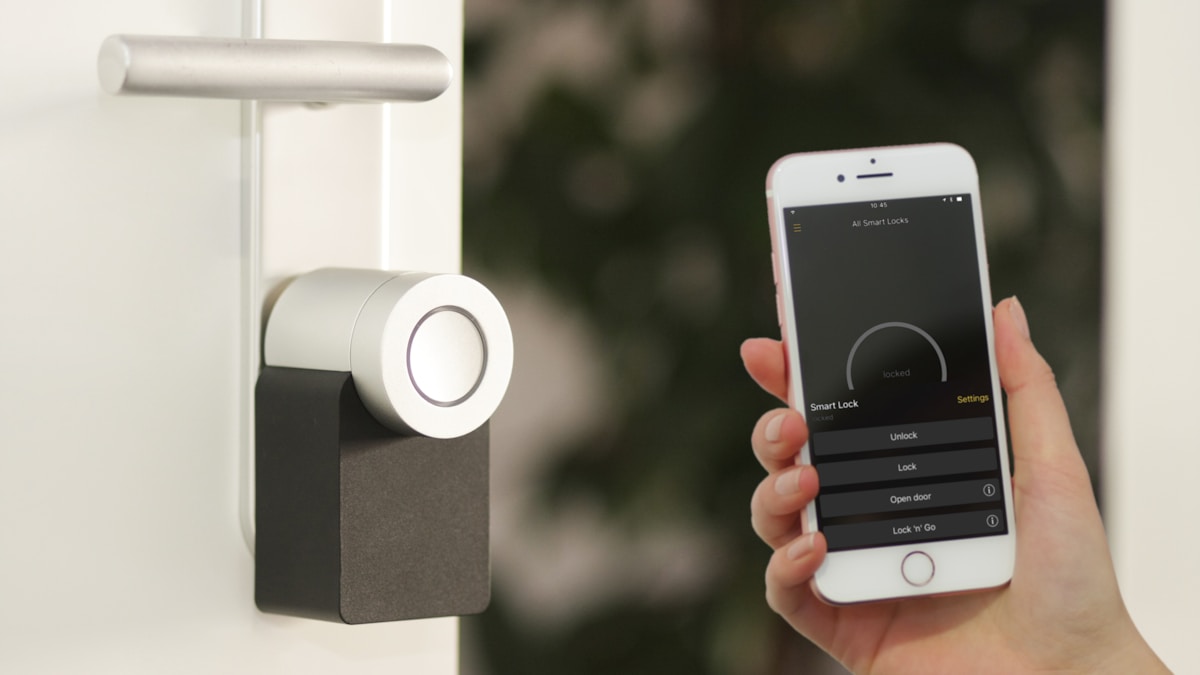
Smart locks are placed in emergency mode during a fire alarm: all doors in the escape route are automatically unlocked so that occupants can leave the building without having to search for keys. At the same time, access for the rescue services is facilitated.
Heating and gas shut-off
Smart thermostats switch off the heating and – especially critical – smart gas valves interrupt the gas supply. This prevents gas from acting as additional fuel that intensifies the fire or triggers an explosion.
All these automations run within seconds, without any occupant having to intervene. They also work when nobody is at home – and considerably reduce fire damage even before the fire brigade arrives.
Water damage protection as a complementary safety layer
Fire protection and water damage protection are more closely linked than most people realise. After a fire has been extinguished, water often causes damage just as high as the fire itself. Furthermore, water damage from defective pipes or overflowing appliances can trigger short circuits, which in turn cause fires.
Modern security systems therefore integrate water detectors as complementary sensors. These detect even the smallest quantities of water on the floor and immediately trigger an alarm. In combination with smart water valves, the water supply can be interrupted automatically – before the damage becomes greater.
Typical installation locations for water detectors are the kitchen, bathroom, cellar, laundry room and the vicinity of dishwasher and washing-machine connections. For commercial properties, we additionally recommend monitoring server rooms and technical utility rooms. The cost of water detectors is minimal compared with the potential damage they prevent.
Conclusion: holistic fire protection saves lives
The smoke detector obligation in Germany was an important and correct step. But whoever relies solely on a simple smoke detector is trusting a technology that lags decades behind the current state of the art. Modern fire protection in the residential area today means:
- Multi-sensor technology for precise detection with minimal false alarms
- Networking of all detectors for building-wide alarm in every room
- Carbon monoxide monitoring as protection against the invisible danger
- Monitoring-centre connection for automatic fire brigade notification around the clock
- Smart Home integration for active protective measures in the event of a fire
- Zone-based architecture for precise localisation of the seat of the fire
- Water damage protection integration as a complementary safety layer
At Protexium Security, we regard fire protection as an integral component of every security concept – not as an isolated duty. Our fire protection systems are embedded in the overall security concept, communicate with intrusion protection and Smart Home components and provide seamless monitoring that saves lives in an emergency.
The investment in professional fire protection is manageable – the consequence of going without can be immeasurable. Let us advise you and protect the most important things: your family and your home.
“A smoke detector fulfils the obligation. A networked fire protection system with monitoring-centre connection saves lives – even when you yourself are not in a position to call emergency services.”